AI hallucinations: why AI makes things up and how to reduce them at work
What AI hallucinations are, why language models make things up and how to reduce them in your company: 7 practical measures, a risk table and common questions.
Richard Böhmer, MSc
An AI assistant answers fluently, confidently and without hesitation. The problem is that it answers just as confidently when it does not know. It invents a number, a legal clause, a quote or a source that does not exist. This is called a hallucination.
An AI hallucination is an answer that sounds convincing but is false or not supported by anything. It does not happen because the model “lies”, but because it generates probable text rather than verified facts. It cannot be removed completely, but it can be reduced substantially: by connecting AI to your own sources, calculating numbers outside the model, testing, and adding review where a mistake matters.
Quick answer
- What it is: an invented or unsupported detail presented as fact - a number, a quote, a source, a name or a date.
- Why it happens: a language model predicts which text should come next. It does not look facts up in a database and cannot tell what it knows from what it has filled in.
- When the risk is highest: with specific numbers, citations, legal and internal information, and anything the model was not given as source material.
- What helps most: answers built on your documents and data with the source shown, numbers calculated in the data layer, the option to say “I don’t know”, and regular testing.
- What is not enough: writing “do not make things up” in the instructions, or simply switching to a newer model.
What is an AI hallucination?
A hallucination is language model output that does not match reality or the source material, even though it is worded as confidently as a correct answer. That is what makes it dangerous: you cannot recognise it by style or tone.
In practice it takes several forms:
- An invented fact or source. A study, court ruling, standard or link that does not exist. There are well-known cases of lawyers filing court documents that cited rulings a chatbot had made up.
- A wrong number. The model adds up, averages or converts figures “in its head” and the result is off.
- Outdated information. The answer reflects the state of things when the model was trained, not today’s price list, legislation or product version.
- The right detail in the wrong place. Revenue of a different branch, terms of a different contract, a parameter of a different product.
- An answer that goes beyond the source. The AI has the document, but adds something that is not in it.
Why does AI make things up?
A language model is not a search engine or a database. From a very large amount of text it has learned how words and sentences usually follow each other, and when answering it assembles the most probable continuation. If the correct answer appeared often in its training text, it usually gets it right. If not, it produces something that looks like a correct answer.
The most common causes in a business setting:
- The model does not have the information. It has never seen your internal price list, your policy or last month’s revenue.
- The question is ambiguous. “What was revenue?” without a period, a branch and a definition of revenue forces the model to guess.
- The sources contradict each other or are out of date. Two versions of the same policy lead to two different answers.
- The model is asked to calculate. Language models are built for working with text, not for exact arithmetic over hundreds of rows.
- The instructions push for an answer at any cost. If the system is not allowed to say “I don’t know”, it will say something.
The important point is that the model does not know it is wrong. Asking “are you sure?” is therefore not a check: the model may confirm a wrong answer and change a correct one.
Where is the risk highest in a company?
| Situation | What can go wrong | What helps |
|---|---|---|
| Questions about numbers (revenue, margin, stock) | an invented or miscalculated figure | the data layer calculates the number, the AI only explains it |
| Internal rules and contracts | an answer from general knowledge instead of your policy | search in your documents and a link to the source |
| Law, tax, regulation | a clause that does not exist, outdated wording | verification in the primary source, review by an expert |
| Customer communication | a promise the company never made (discount, deadline, warranty) | a narrow range of topics, approved source material, handover to a person |
| Summaries of long documents | an omitted caveat or an added conclusion | checking the key points against the original |
The risk is lower for tasks where you see the result immediately and can judge it yourself: rewording a text, drafting an outline, translating a working e-mail or brainstorming.
7 measures that reduce hallucinations
1. Build answers on your own sources
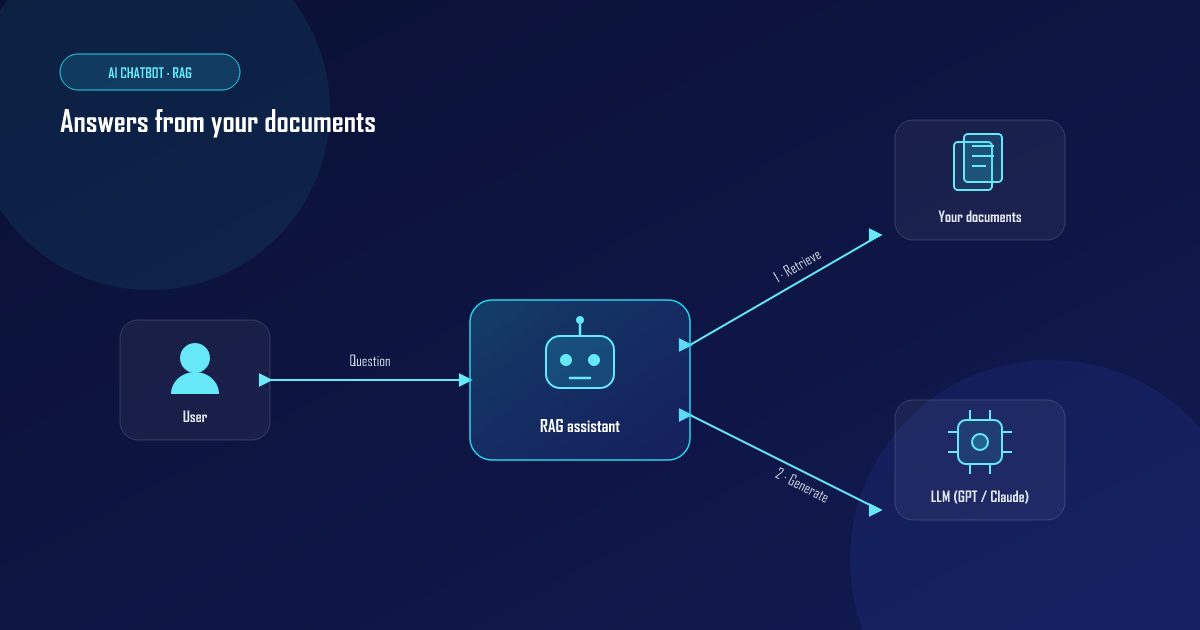
Instead of answering “from memory”, the AI first finds the relevant passages in your documents and composes the answer from them. This approach is called RAG and we describe it in detail in An AI chatbot over your documents. Every answer should show its source so that a person can verify it quickly.
2. Let the data layer calculate the numbers
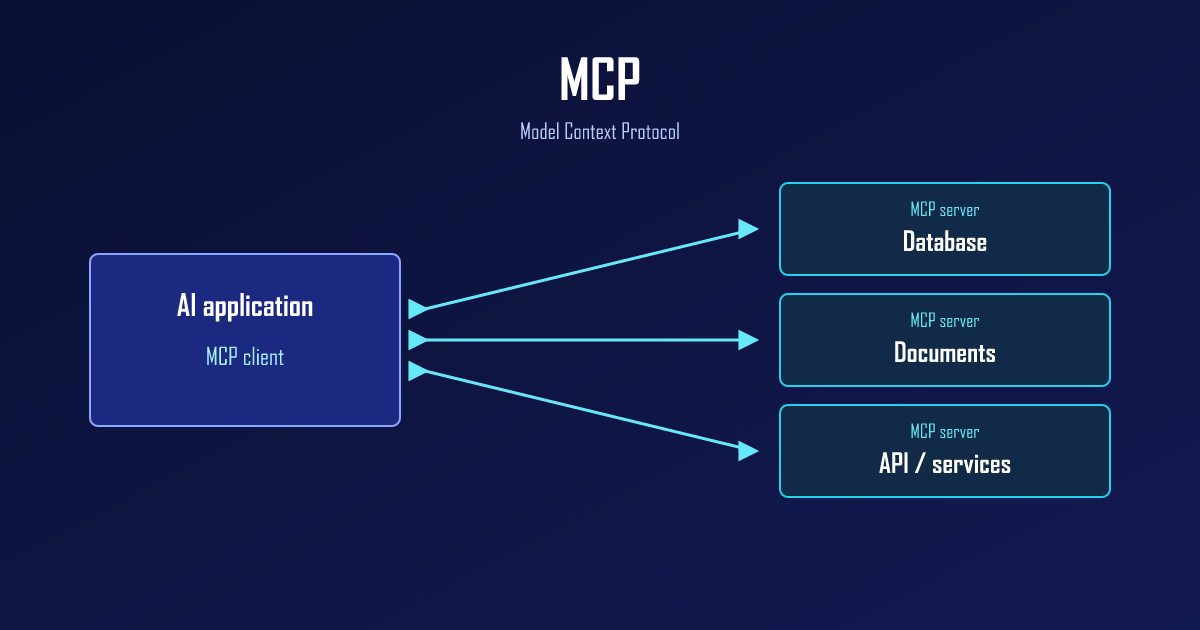
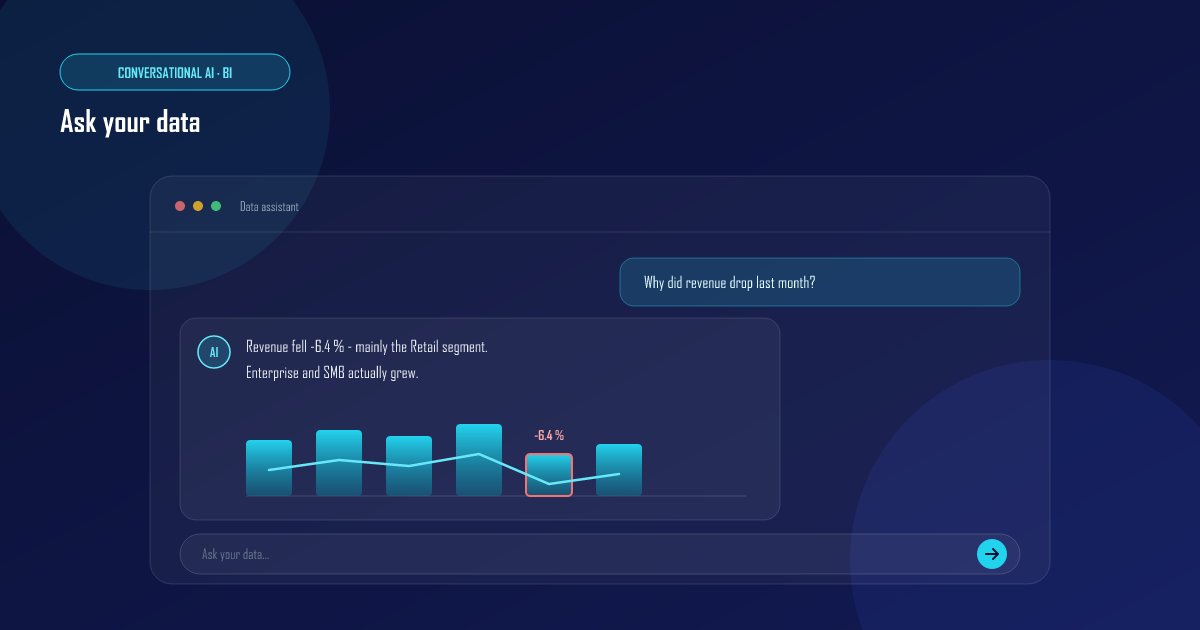
The model should not estimate or add up revenue, margins and counts. It should call a tool that calculates the result from your data according to an agreed definition, and then explain that result. This is the principle behind the connections we build with MCP and behind AskData, our AI assistant for business data.
3. Allow the AI to say “I don’t know”
The system needs a clear rule: if the answer is not in the source material, it says so and offers a next step, such as a contact for the person responsible. An admitted gap is better than a convincing mistake.
4. Narrow the scope and agree on definitions
A customer support assistant does not need to answer questions about tax. The narrower and clearer the scope, the less room there is for filling in gaps. The same applies to terms: if the company has three definitions of margin, the AI will pick one for you. That is why it pays to start with a trustworthy data foundation.
5. Keep the sources current and clean
AI repeats what it finds. A policy that is no longer valid, duplicate versions of documents or incorrect records in a system go straight into the answers. Order in the source material is therefore part of an AI project, not an optional extra. More in our article on data quality.
6. Test on questions with a known answer
Before launch, prepare a set of real questions for which you know the correct answer, including some the system should answer with “I don’t know”. Run the same set after every change of model, instructions or sources. Without it you cannot tell whether quality has improved or got worse.
7. Set human review according to risk
A draft of an internal note does not need review. A reply to a customer about a complaint, contract wording or a number that goes into a financial statement does. Decide in advance which outputs a person approves, and log questions and answers so that mistakes can be traced and corrected.
What does not work, or is not enough
- The instruction “do not make things up”. It helps a little, but the model cannot reliably tell what it has invented.
- Only a newer or larger model. A better model usually makes fewer mistakes, but without access to your data it has nothing to base a correct answer on.
- RAG without control over the sources. If the search finds the wrong or an outdated document, the AI will build a wrong answer from it.
- Trusting a confident tone. How certain an answer sounds says nothing about whether it is correct.
Five habits for everyone who uses AI
Technical measures are not enough if people treat every answer as an established fact. These rules are worth adding to your internal AI usage policy:
- For facts, ask for the source and open it.
- Always verify numbers, names, dates, quotes and legal references.
- Give the AI source material, such as a document or a table, rather than a question with no context.
- Do not rely on a single answer for an important decision.
- Report mistakes so that they can be fixed at the source.
If you are still deciding which tool people will work with, our comparison of Copilot, ChatGPT, Claude and Gemini will help.
Frequently asked questions
Can hallucinations be prevented completely?
No. With today’s language models they can be reduced substantially, not ruled out. The goal is therefore not a zero error rate, but a solution in which a mistake is rare, visible and, for important outputs, caught before it causes damage.
Does AI connected to company data still hallucinate?
Less, but yes. It can pick the wrong document, misunderstand the question or add a detail that is not in the source. That is why links to the source, testing and numbers calculated outside the model matter.
Which AI model hallucinates the least?
It depends on the type of task and changes with every new version. General leaderboards tell you little; what decides is a test on your own questions and documents. We cover how to approach the choice in which AI model your company should choose.
How can I tell that the AI is making something up?
Not reliably from the text alone. Warning signs are very specific details without a source, links that cannot be opened, and answers that change when you repeat the question. Only checking the original source gives you certainty.
Is a hallucination the same as an error in the data?
No. In a hallucination the model creates the detail. With an error in the data, the AI correctly repeats an incorrect record from a system. They look the same from the outside, but the fix is different: the first is a matter of how the AI solution is designed, the second a matter of data quality.
Want AI whose answers can be verified?
At RBH Technology we design AI solutions over company documents and data so that the answer shows its source, the numbers come from the data layer and quality can be measured. We start with one specific use case and a set of test questions.
Book a free consultation. We will go through where you use AI or want to use it and where the risk of a wrong answer is highest. For an overview of what we do, see AI projects.