You have data but don't trust it? A guide to data quality for companies
When two reports contradict each other, the problem isn't the people - it's data quality. We show what data quality means, how much bad data costs you and how to get it under control.
Richard Böhmer, MSc
You know the scene. Sales claims it made 1.2 million in revenue. Finance says 1.1 million. Both sides have „their report” and both stand by it. The result? Instead of making a decision, you spend an hour arguing about which number is actually valid.
And yet the problem is almost never the people. It’s data quality. The good news is that it can be brought under control.
What data quality is
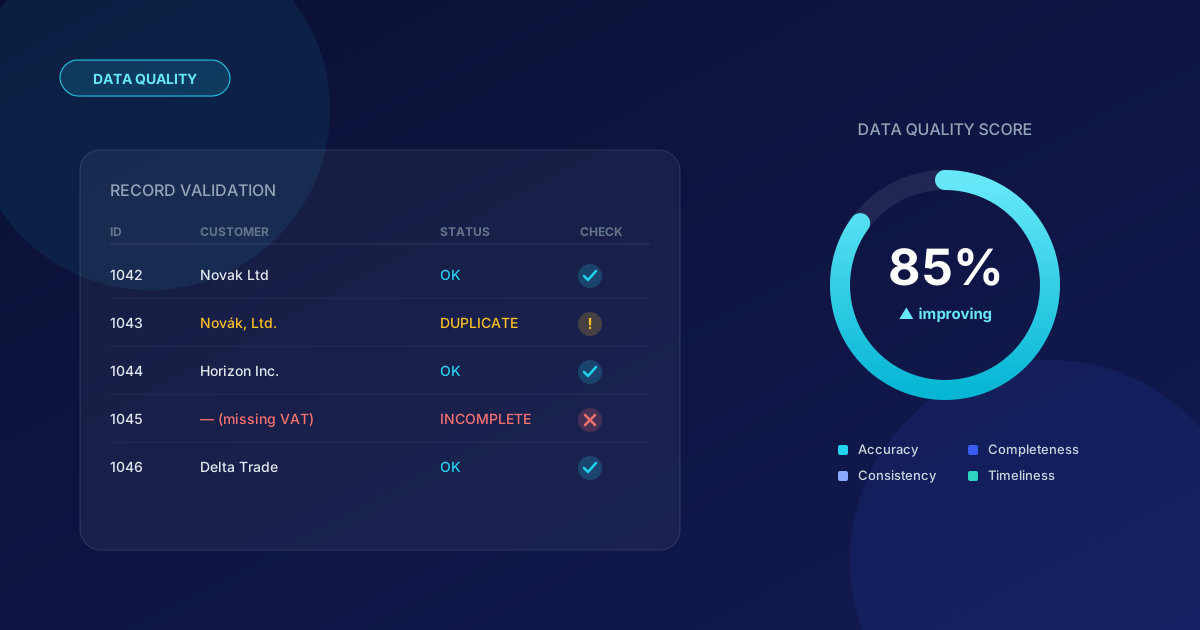
Data quality is not „we have data / we don’t have data”. It’s the degree to which you can rely on data when making decisions. It is measured across several dimensions:
- Accuracy - does the data match reality? (Is the customer’s address real?)
- Completeness - are key values missing? (Does every invoice have a company ID?)
- Consistency - do different systems say the same thing? (Are „Novák Ltd” and „Novak, Ltd.” one customer or two?)
- Timeliness - is the data fresh enough to decide on? (Am I seeing today’s state or last week’s?)
- Uniqueness - are records duplicated? (Are we paying one supplier twice?)
- Validity - does the data fit the expected format? (Is a date really a date, not text?)
Just one failing dimension is enough for the whole report to lose trust.
How much bad data actually costs you
Bad data is not a „technical detail”. It’s a real cost - it just doesn’t show up on a single invoice:
| Symptom | What it costs the company |
|---|---|
| Manual fixes and reconciling reports | Dozens of hours a month |
| Decisions based on wrong numbers | Mispriced products, wrong stock, wrong campaigns |
| Duplicate customers / suppliers | Double payments, distorted analyses |
| Distrust in the outputs | People build their „own” spreadsheets, chaos grows |
| Complaints and fines | Wrong invoices, incorrect filings |
According to various industry estimates, poor data quality costs companies single to double-digit percentages of revenue - mostly hidden, in lost time and bad decisions.
Where bad data comes from
Usually not from one big failure, but from many small ones:
- Manual re-keying between systems (typos, skipped fields).
- Different systems, different definitions - what „active customer” means in the CRM may differ from accounting.
- No validation on entry - a form that accepts empty or nonsensical values.
- Historical data pulled from old systems without cleaning.
- No one owns it - when no specific person is responsible for data quality, it doesn’t improve.
How to get data quality under control
Good news: data quality is not solved by „being more careful”. It’s solved by a system.
1. A single source of truth
Instead of each department pulling numbers its own way, data is gathered into one place - a data warehouse - where definitions are unified. „Revenue” means the same for sales and finance. We write about when the time is right in the article Data warehouse or Excel?.
2. Automated data testing
This is the key. Data can be checked automatically on every run - whether values are missing, whether there are duplicates, whether numbers add up. Tools like dbt can run these tests on every refresh and flag issues earlier, before an error reaches the report. We cover it in the article dbt: turning raw data into information you can trust.
3. Validation on entry
The cheapest place to fix an error is where it’s created. Required fields, format validation, picking from a list instead of free text - small things, big difference.
4. Ownership and governance
Data quality needs an owner - a person or team responsible for making sure definitions hold and errors get resolved. It doesn’t have to be heavy bureaucracy; a clear rule of „who decides what each metric means” is enough.
First steps
You don’t have to do everything at once. Start where it hurts the most:
- Pick one report you don’t trust and find out why the numbers diverge.
- Define the key metrics - what exactly revenue, customer, margin mean.
- Add a few automated tests on the most important data.
- Assign an owner for data quality.
The goal isn’t „perfect data”. The goal is data you trust enough to decide on without hesitation.
Struggling with numbers you can’t trust? Take a look at our data warehouse and data analytics services, or book a free consultation - we’ll find where your data loses its credibility.