dbt: turning raw data into information you can trust
dbt (data build tool) brings order, testing and documentation to data transformation. A practical look at what dbt is, when it makes sense - and when it is needless complexity.
Richard Böhmer, MSc
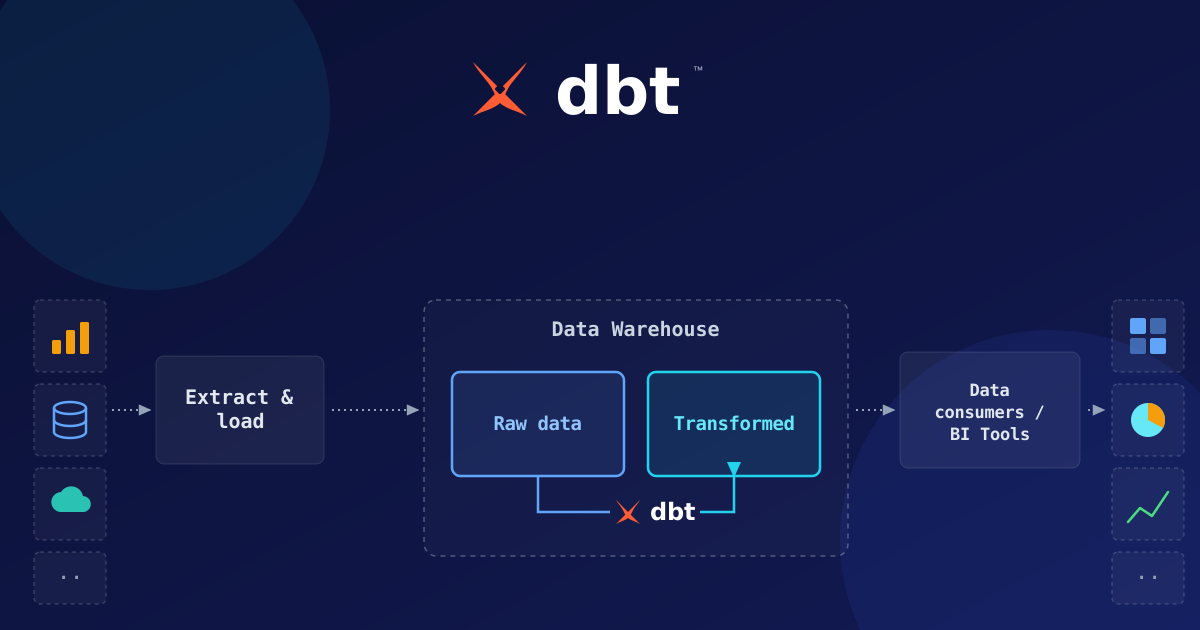
Raw data from your ERP, CRM or e-shop delivers no value on its own. Value appears only when you transform it into a form you can trust - clean, consistent and with a clear definition of your metrics. It is exactly at this stage that dbt (data build tool) has become the standard in recent years.
What dbt is
dbt is a tool for transforming data directly inside the data warehouse using SQL. It fits the ELT approach (Extract, Load, Transform): data is first loaded into the warehouse (Snowflake, BigQuery, Microsoft Fabric, Databricks, PostgreSQL and others) and only then transformed. dbt takes care of precisely that letter T.
It’s important to understand what dbt is not: it is not a database and not a tool for loading data. It is a layer that takes your SQL and turns it into a manageable, testable and documented project - much like software developers work with their code.
dbt comes in two forms:
- dbt Core - open-source and free. You run it on your own infrastructure. Suitable for teams that want control and flexibility.
- dbt Cloud - a paid hosted version with run scheduling, a web IDE and support. Suitable for teams that prefer convenience over managing infrastructure.
Why the whole data world is talking about it
1. Transformations in the SQL you already know
dbt does not introduce a new language. You write SQL, which most data people already know. dbt adds templating (Jinja) on top, so you can avoid copying the same logic into ten places.
2. Modularity instead of one giant query
Each transformation is a separate model that can reference another model. Instead of one unmaintainable 2,000-line SQL script, you have clear, reusable building blocks.
3. Data quality testing
dbt lets you define tests directly - whether a column is unique, whether values are missing, whether a value fits a lookup list. You catch data errors before they reach a management report.
4. Automatic documentation and data lineage
dbt generates documentation and a data flow graph (data lineage) - you see which sources each metric comes from and what happens when you change a single model. No more “where does this number come from?“.
5. Version control and collaboration through Git
Models live in Git. The team can do code reviews, roll back to history and deploy changes in a controlled way - the same discipline ordinary software development has.
6. Efficiency at large volumes
Incremental models transform only new or changed data instead of the whole dataset. Snapshots capture historical state - the basis for analysing trends and changes over time.
How dbt works in practice
- Model development - an analyst or engineer writes SQL that defines a transformation. It is saved as a model in the dbt project.
- Compilation and execution - dbt compiles the models into SQL and runs them against the data warehouse. Tables and views with cleaned data are created.
- Testing and documentation - dbt runs the defined tests and generates documentation and lineage.
The result is one version of the truth on which Power BI, other reports and AI models can stand.
When dbt makes sense - and when it doesn’t
To keep it balanced: dbt is not a solution for everything.
It makes sense when:
- you have a data warehouse (or are building one) and transformations keep growing,
- multiple reports depend on the same metrics and you want one definition,
- you need quality, tests and documentation, not just “it somehow runs”,
- several people work on the data and you need collaboration without chaos.
Consider whether you need it when:
- you’re a small company with one system and a few reports - Power BI directly on the source is enough,
- you don’t have a data warehouse yet - dbt isn’t the first step, it’s a layer on top of already-loaded data,
- you have no one on the team who knows SQL and wants to maintain the transformations.
What to take away
dbt is a step forward in data engineering because it brings the discipline common in software development into transformations - modularity, tests, versioning and documentation. It’s not a magic shortcut, but for companies with a real data warehouse it is one of the most reliable ways to turn raw data into information you can trust.
Considering dbt or building the data warehouse it will sit on? See our services or contact us - we’ll be happy to look at your specific situation and propose a tailored solution.