How much does a data warehouse or BI project cost? (and what drives the price)
No evasive answers. We show what makes up the cost of a data warehouse and BI project, what the realistic ranges are and how to get the most out of your budget.
Richard Böhmer, MSc
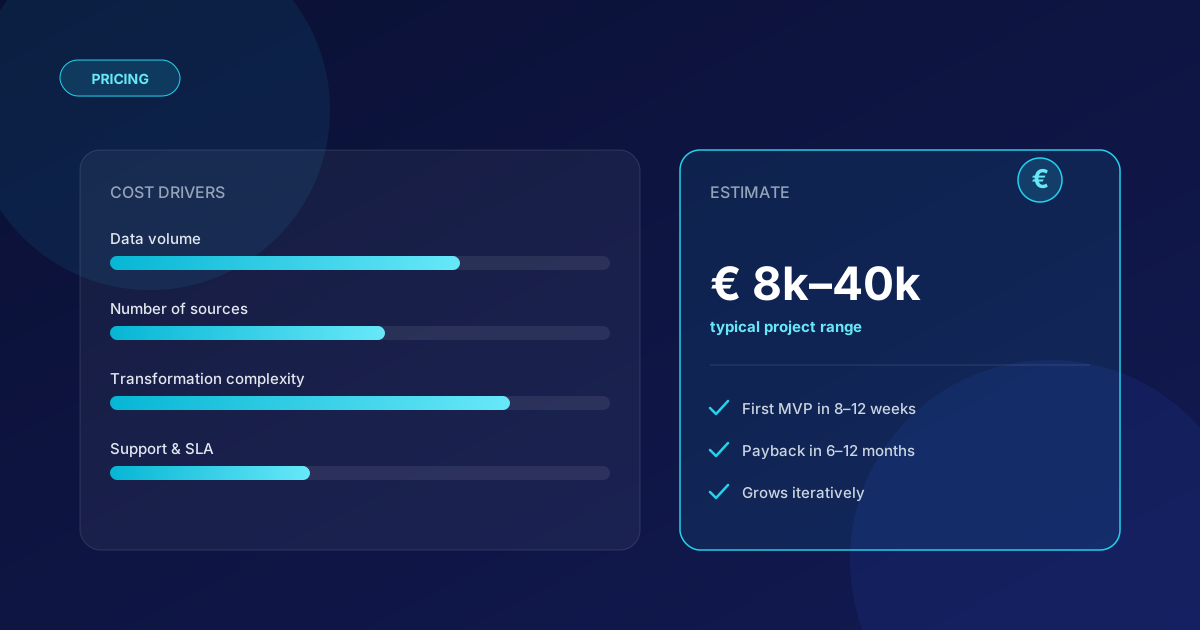
„How much will it cost?” A perfectly legitimate first question - and also the one most vendors answer with an annoying „it depends”. This article is about what it actually depends on, what the indicative ranges are and how to get the most out of your budget. No marketing, with real numbers.
Why there is no single price tag
A data warehouse or BI project is not a boxed product. It is a solution tailored to your data and processes. Just like building a house - „how much does a house cost?” has no single answer until we know the size, materials and location.
The good news: the price can be estimated well right after a short analysis. Even better: you can almost always start small and grow gradually, so you don’t have to spend the whole budget up front.
What drives the price
These are the five main factors that push the price up or down:
- Number and type of data sources - one accounting system is very different from 12 systems + APIs + Excel files. Each source has to be connected, understood and tested.
- Data volume and quality - large volumes and „dirty” data (duplicates, missing values) mean more work on cleaning and transformations.
- Logic complexity - how many business rules, calculations and metrics need to be built. Simple KPIs vs. complex financial consolidations are a different league.
- Number and complexity of reports - five dashboards is different from reporting for a whole organisation with self-service.
- Operations and support - one-off delivery vs. long-term support, SLA, development and training.
On top of that comes the choice of cloud vs. on-premise and the technologies used (Power BI, Azure, Snowflake, an open-source stack).
Indicative ranges
Treat the following numbers as a framework, not a price list - the real price comes out of a short analysis. These are typical ranges for small and mid-sized companies:
| Scope | What it includes | Indicative price |
|---|---|---|
| MVP / pilot | 1-2 sources, one data model, 1-3 dashboards, automated ingestion | from € 8,000 |
| Mid-sized project | 3-6 sources, data warehouse, a set of reports, self-service | € 15,000 - 40,000 |
| Enterprise | 7+ sources, complex transformations, governance, forecasts | custom (from € 40,000) |
Most companies start with an MVP - it delivers value quickly, and the budget for further phases is easier to approve once results are visible.
One-off vs. ongoing costs
This is often forgotten. A project’s cost has two parts:
- One-off - design, development, deployment (the numbers above).
- Ongoing monthly - licences (e.g. Power BI ~ a few € per user per month), cloud (usage-based, often tens to low hundreds of € per month for an SME), and maintenance/development as agreed.
A good vendor names both parts up front, so nothing surprises you.
How to lower the price without losing value
- Start with an MVP on the most painful area - not „everything at once”.
- Prioritise reports that actually influence decisions, not „nice to have”.
- Iterate - add sources and views as you see the return.
- Keep your data - insist that the architecture and code are yours, with no vendor lock-in.
- Pick a partner, not a licence reseller - a vendor-neutral approach often saves more than it costs.
Return: the price is not a cost, it’s an investment
A data project typically pays back in 6-12 months - mainly through saved time (no more manual report assembly) and better decisions (right prices, stock, campaigns). Add fewer errors and less firefighting, and the return is even faster.
If you’re weighing up whether to take the step away from Excel at all, the article Data warehouse or Excel? helps, and for the big picture What is business intelligence.
How we do it
- Free consultation - we understand your situation and goals.
- Short analysis - we map the sources, scope and prepare a concrete quote (no fees).
- MVP - we deliver the first usable version, on real data.
- Development - we grow iteratively, based on priorities and budget.
The goal is not „the biggest project”, but the fastest path to value for a reasonable price.
Want a concrete number for your situation? Take a look at our data warehouse and data strategy services, or book a free consultation - we’ll prepare an indicative estimate.